An AI assistant that can create a task, edit a document, or reassign a piece of work faces the same decision every time it acts: do this now, or hold it and ask first. Get that decision wrong in one direction and the assistant starts changing things nobody approved. Get it wrong in the other direction and every useful action arrives wrapped in a confirmation prompt, and prompts that show up constantly get approved on reflex, the same way most people tap “Allow” without reading what a permissions dialog actually grants.
That reflex is the real risk in over-asking. A system that confirms before every action looks careful in a demo. In daily use it trains people to stop reading the question, so the one time the answer should have been no, nobody catches it. Someone has to draw that line before the assistant ever hits the ambiguous case in the field, deciding in advance which wrong guesses are worth a pause and which ones are cheap enough to just make.
Where the two costs actually land
At Dutify, this decision sits behind every write that AI Coworker, the assistant built into Slack, Teams, and the API, can make on a person’s behalf: a task in Dutify Cloud, a page in Codexum, a comment on a public board in Roadmarq, a follow-up drafted from a call in Dutify Hub. Each of those can be edited by a person directly or by AI Coworker acting for one, and every edit raises the same question before it happens: does this go through now, or does it wait for a yes. That call belongs to whoever runs the team the assistant is working for. Dutify doesn’t set one threshold that applies the same way to every workspace, because a channel used for customer replies and a channel used for internal notes don’t carry the same risk when a guess is wrong.
The four don’t carry the same cost when the answer is wrong. A task assigned to the wrong person on a Dutify Cloud board is usually caught and fixed the same day by whoever owns that board. A page rewritten in Codexum can already have been read, quoted in a Slack thread, or linked from somewhere else before anyone notices the edit was off. A comment posted to a public Roadmarq board is visible to the customers who voted for the feature it’s attached to. Same kind of action, a write, with three different amounts of damage if it’s wrong.
That difference is the actual filter, not “ask more” or “ask less” applied uniformly across the board. It comes down to how easily a wrong write gets undone, and who is exposed to it before anyone gets the chance to undo it.
Confirming everything doesn’t survive contact with a real week
Engineering teams already have a name for what happens when a system asks for the same kind of confirmation too often: alert fatigue, the term security and on-call teams use once someone has clicked through the tenth low-stakes alert in a shift. The confirmation itself doesn’t get less true, but whoever is clicking through it gets less attentive with each one that looks the same as the last one. An assistant that asks before every task edit and every wiki edit produces the same curve: the first few confirmations get read closely, and by the twentieth, the click happens before the card does.
Asking before everything sounds cautious until the confirmations start blurring together, and then it stops protecting the one decision that actually needed a careful look. Asking only where a wrong guess is expensive enough to deserve that attention, and defaulting everything else to something correctable, is what keeps the confirmation meaningful on the occasions it does show up.
A card waiting for a click
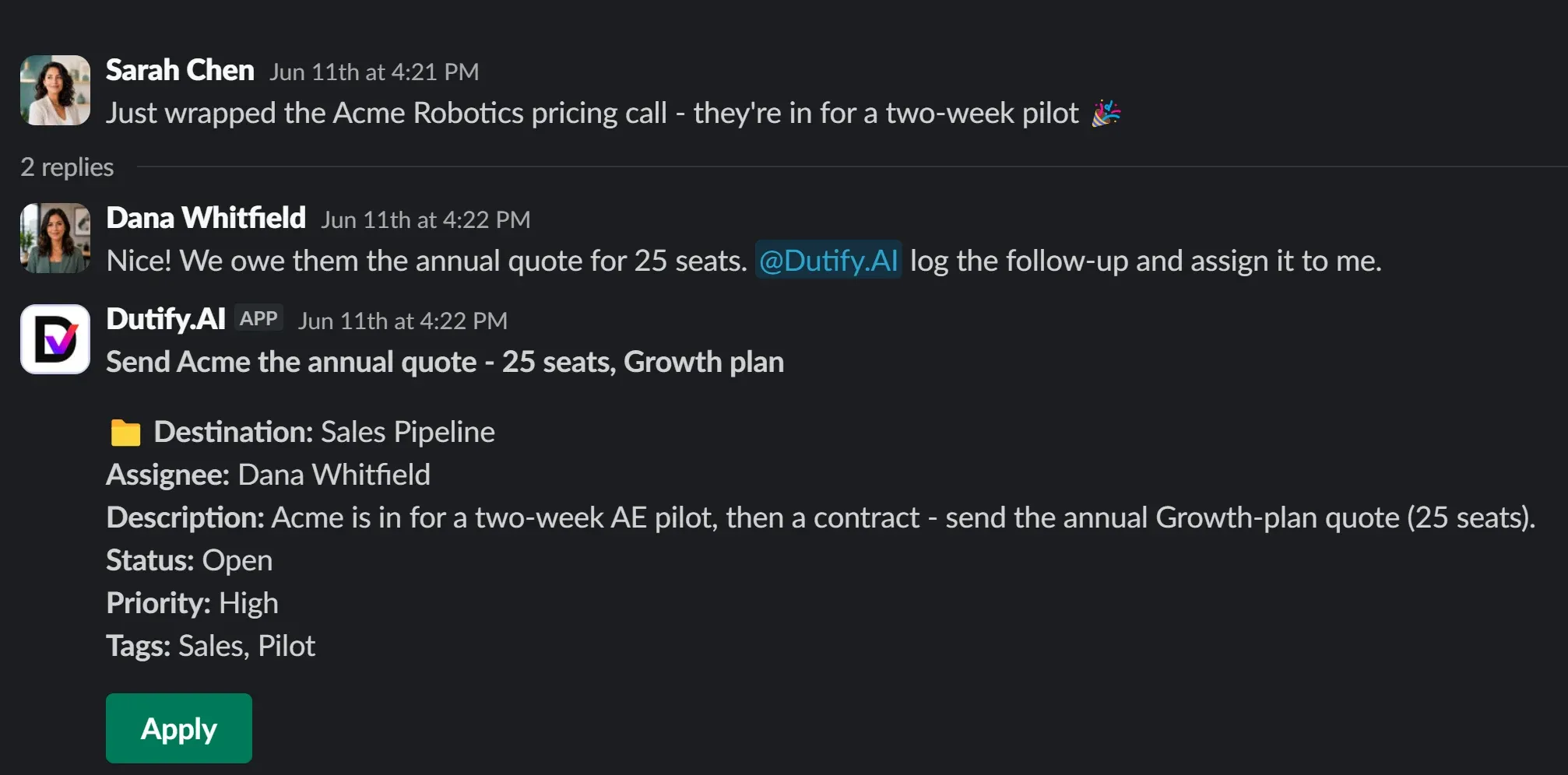
Dutify Hub’s AI notetaker listens to a recorded call and drafts the follow-up work out of it: a destination list, an assignee, and a set of fields, guessed from who said what and to whom. None of that guessing waits for anyone. What waits is the last step, actually creating the task in Dutify Cloud, which the notetaker holds as a card until someone applies it. A card that sits unapplied doesn’t quietly take effect in the background. Nothing changes on the board until someone clicks, so a card nobody gets to yet has cost the team nothing.
The split maps onto the filter above pretty directly. Guessing the assignee wrong costs one edit to a task nobody else has acted on yet, so that guess is safe to make by default. Committing the guess into Dutify Cloud is what actually notifies someone and puts the task on their board, where it can sit for hours before anyone reviews it, so that step gets a click instead of a default.
The same question in a wiki
A team wiki adds a property that a task board doesn’t have: once something is written there, it’s often the only copy anyone consults afterward. An ambiguity that’s cheap to leave unresolved on a task gets expensive to leave unresolved on a page.
Suppose the same assistant is asked, from a Slack thread about a decision the team just made, to write it up somewhere like Codexum. Capturing the decision isn’t the ambiguous part. Where it goes is: a new page next to related ones, a section appended to a page that already covers the topic, or an edit to a paragraph that turns out to contradict what’s already written there.
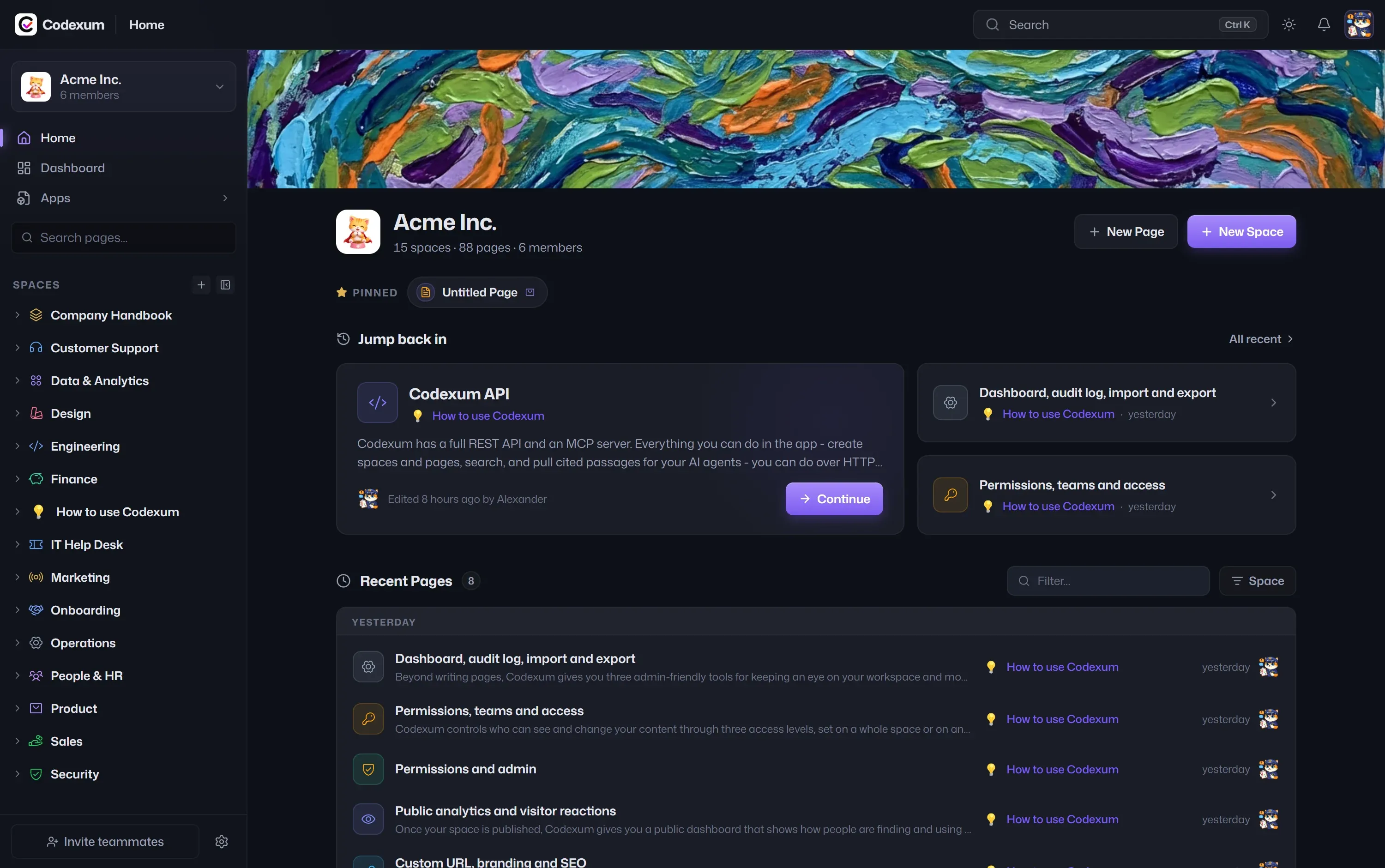
Guessed wrong, the cheapest failure is a duplicate page someone has to merge later. The expensive failure is an edit landing on a page somebody already has open, or one published out to a help center or docs site where the previous version was already the answer someone gave a customer. Creating a new page is reversible by deleting it. Overwriting content that predates the request stops being reversible the moment anyone has read the old version, which is why treating “add” and “overwrite” as the same action, just because they were triggered by the same sentence in Slack, is where this kind of assistant gets a team into trouble. One way to keep that from turning into a coin flip is to make appending the default and reserve overwriting an existing paragraph for a request that says so directly. A page left with one redundant section is a mistake worth living with, since nobody has already relied on the wrong version. An edit that quietly changes what a paragraph said an hour ago is a different kind of mistake, because someone may have already read it.
The line moves, deliberately
None of this gets set once at rollout and left alone. The dividing line between what the assistant defaults on and what it confirms should move as a team sees which of its guesses actually hold up.
If AI Coworker keeps assigning the right owner in one Slack channel for months without a correction, a team can reasonably stop asking for that particular guess in that particular channel. If it keeps guessing the wrong list for a different kind of request, that judgment goes back into confirm territory, whatever the setup originally assumed. What doesn’t move with the track record is anything where a rare miss stays expensive no matter how rare it gets: overwriting a wiki page other people rely on, or posting to a board customers can see. A better hit rate doesn’t shrink the cost of the miss that still happens.
A tempting way to sidestep the whole problem is to make everything reversible: version history for a wiki page, an edit log for a task, a delete option for a public comment, then let the assistant guess freely since nothing sticks for good. Version history restores the words. It does nothing about the person who already read the wrong version, or the customer who already got a notification about a comment that no longer exists. The record can be fixed after the fact. Who already acted on it cannot, which is why the line has to sit before the write happens.
That’s the actual work behind giving an assistant access to a team’s tools: not one permissions toggle, but a running judgment about which mistakes are cheap enough to fix after the fact and which ones need someone to see them before they land. Where AI Coworker draws that line today across Dutify Cloud, Codexum, and Roadmarq is the product of exactly that judgment, tested and adjusted against real calls and real threads rather than decided once in the abstract.